
Effective Haul Road Management: A South American Gold Mine Case Study
Type: Productivity
Site: Large Open Pit Gold Mine
Location: South America
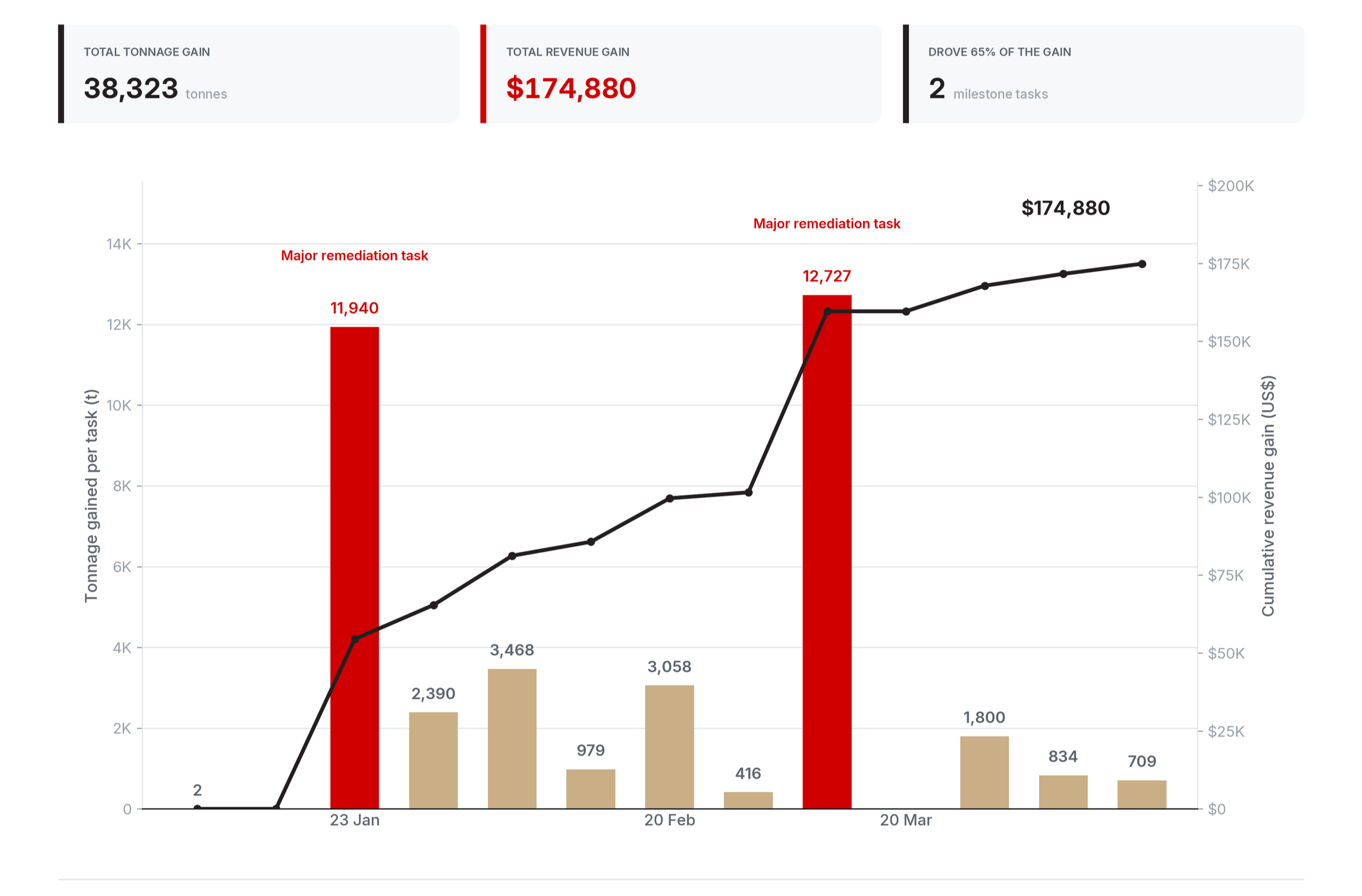
Outcome:↑ Increased production by 38,000 tonnes per week, translating to an estimated incremental revenue of $174,880.
The Task
Effective haul road management is crucial for optimising productivity and minimising costs in the mining industry. This case study highlights how a South American gold mine utilised Haul Road Explorer (HRE) to identify and address a significant haul road bottleneck, resulting in substantial operational improvements.
The mine operated with a known bottleneck on its main haul ramp, restricting traffic to one-way operations. This was the result of continuous poor weather inducing a landslip event, narrowing the road. While the issue was recognised, the mine struggled to quantify the exact impact on production and remediation works were consequently mothballed. This bottleneck, combined with the management of an extensive road network, posed significant challenges in optimising operations and controlling costs.
The Solution
Investigation
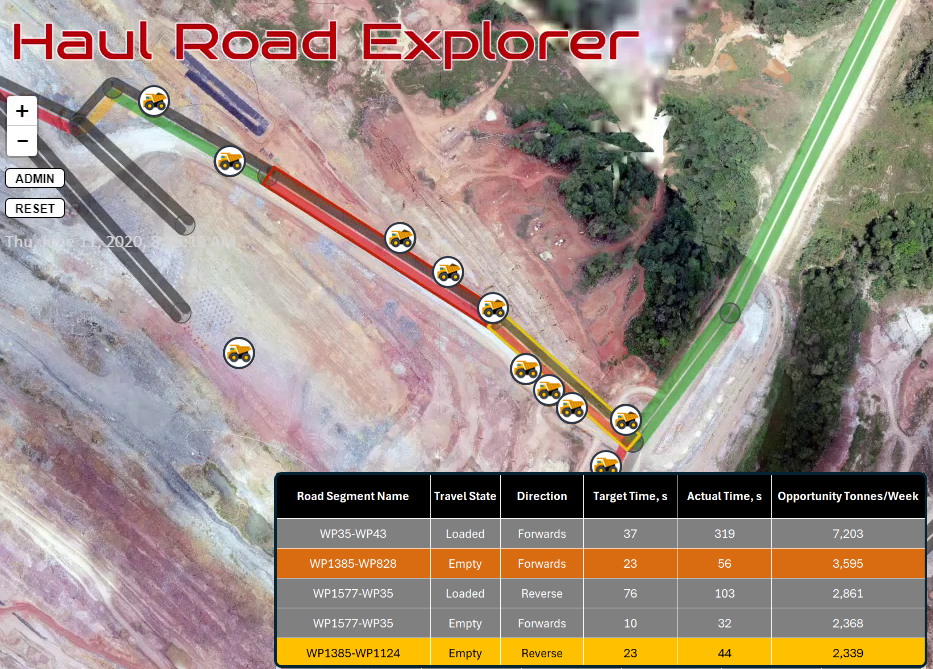
Upon implementing HRE, the mine initiated an investigation into the impact of the haul road bottleneck. By employing the Road Work Priority Assistant (RWPA) tool, the mine quickly identified the main haul ramp as one of the top five roads experiencing the highest tonnage losses. It was estimated that a total of 6,000 tonnes per week were being lost on this ramp.
Further analysis using the replay tool provided a clear visualisation of haul truck traffic flow. The tool revealed that empty trucks entering the pit were forced to come to a near standstill to allow priority-loaded trucks to exit. HRE clearly demonstrated the severity of the bottleneck and its detrimental effect on productivity.
To enhance the investigation process, the mine leveraged HRE’s inspection tool to capture and geolocate images of road conditions. This visual documentation provided a comprehensive overview of the road network, further enabling rapid identification of potential issues. By sharing these images with road maintenance teams, the mine facilitated prompt and targeted repairs.
Based on the findings of the investigation, the mine prioritised remediation works on the main haul ramp. HRE was instrumental in quantifying the impacts of the bottlenecked road. To optimise overall haul road performance, the mine implemented a comprehensive approach:
Tactical Actions:
Prioritisation and Task Management: HRE was used to identify critical road segments and assign tasks to drive accountability and track progress.
Immediate Remediation: Material blockage was cleared from the road surface, re-establishing two-way traffic and restoring productivity.
Preventative Measures: Drainage infrastructure on the ramp was improved to effectively manage water runoff and prevent the recurrence of road narrowing.
Strategic Actions:
Integrated Planning: Road maintenance was formally integrated into weekly operational planning cycles, ensuring proactive issue resolution.
Prioritisation: A focus on high-return-on-investment (ROI) repairs was implemented, shifting resources from cosmetic fixes to critical maintenance.
Collaborative Framework: Clear roles and responsibilities were defined for different teams, fostering a collaborative approach and efficient problem-solving.
Data-Driven Decision Making: HRE continued use provided valuable data to inform road maintenance, repairs, and resource allocation.
The Results
The implementation of HRE and subsequent remediation efforts yielded impressive results:
Increased Throughput: By eliminating the bottleneck on the main haul ramp, the mine achieved a remarkable increase of 38,000 tonnes per week (est. incremental haulage network throughput), translating to an estimated incremental revenue of $174,880.
Reduced Road Alarms: The frequency of road-related alarms from trucks decreased by 43%, indicating improved road conditions and reduced equipment damage.
Improved Road Maintenance: Integrating road maintenance into weekly planning cycles enhanced proactive issue resolution.
Summary
This case study underscores the value of HRE in identifying and addressing critical haul road challenges. By quantifying the impact of the bottleneck and implementing targeted solutions, the mine achieved significant productivity gains and cost savings. This success story highlights the importance of data-driven decision-making, collaboration, and technology in optimising haul road performance.
Frequently Asked Questions
-
Because "we know it's a problem" isn't the same as "we know what it's costing us." This mine had already recognised the ramp restriction, caused by a landslip narrowing the road — but without a number attached to it, remediation lost the argument for budget against other priorities. Once HRE quantified the loss, the same fix that had sat mothballed suddenly had a business case behind it.
-
Because the ramp wasn't just losing its own traffic — it was gating everything behind it. The 6,000 tonnes a week was the loss estimated directly on the ramp itself. But the ramp's one-way restriction forced empty trucks entering the pit to a near standstill every time a loaded truck needed to exit, which slowed the entire haulage network behind it. Fixing the ramp didn't just recover the ramp's own loss — it released a bottleneck the whole site had been working around.
-
Rank them by what they're actually costing, not by how visible they are. MTS used HRE's Road Work Priority Assistant to rank every road segment by tonnage loss, and the main haul ramp came out in the top five sitewide. That ranking is what turned a known but deprioritised issue into the first thing fixed, ahead of repairs that may have looked more urgent but cost less.
-
Three things, alongside the road repair itself. Road maintenance was built into weekly operational planning instead of being handled ad hoc. Repair spending was reprioritised toward high-return fixes rather than cosmetic ones. And roles across maintenance and operations teams were clearly defined, so a future bottleneck wouldn't sit unfixed the way this one did.
